Showing posts with label Sustainability. Show all posts

Tuesday, 2 March 2010

So why should I worry?

The Atlantic Monthly has some interesting observations on the disconnect between acknowleging the reality of climate change and actually believing it will have a personal effect.
Yale climate change research scientist Anthony Leiserowitz. The survey asked Americans, “Who will be most harmed by climate change?” Respondents said that climate change would mostly affect:

• Plant and animal species: 45 percent

• Future generations of people: 44 percent

• People in developing countries: 31 percent

• People in other industrialized nations: 22 percent

• People in the United States: 21 percent

• Your local community: 13 percent

• Your family: 11 percent

You personally: 10 percent

This explains a lot.  Most importantly it explains the lack of urgency to prevent the worst climate change scenario.  Climate change is believed to be true, but in practice, supporting change with personal implications, like gas tax increases, get little support.  It is little wonder that politicians, even those who understand the implications, are so unwilling to act.

The study also showed that Americans are not alone in this.  The disconnect is a world wide phenomenon. 

Wednesday, 11 November 2009

Oil crunch

It has been awhile since posting anything here. So here are some miscellaneous items around a predicted energy crunch:
From popular science an interesting chart that is likely wildly optimistic and news of several former staff members. “IEA Whistleblower Claims Agency Has Downplayed Looming Oil Shortage According to a senior International Energy Agency official, the energy watchdog agency fears the truth would trigger panic buying.” Of course former staff members who refuse to give their names may not be the most reliable sources. Still, look at the chart. It is likely wishful thinking.
To back up the concern, here is a recent Glob & Mail blog by Jeff Rubin:
"At that rate, the world has to find no less than 20 million barrels per day of new production just so the global economy can burn the same amount of oil in 2014 as it burns today. That’s why, in the oil business, you have to run faster to stand still. And even if global production can keep up with that treadmill, that leaves no allowance for any growth in demand."
What will this mean for house prices? I hope you are living close to work, shopping, and schools. If you want to move to those locations, be prepared to pay more.

Monday, 24 August 2009

Limited Energy Options


The following is from the David Hughes presentation summary given on March 9 to the Alliance for a Sustainable Colorado. We simply can not continue consuming in the way we have accepted as normal in our life time. The car culture, the Wal-mart culture, the suburban culture, the consumer society. . . . all of it, will change. Our children, in our life time, will ask us why we consumed so much and left so little for them. Hughes, a retired geoscientist with the Geological Survey of Canada, makes five essential points.
  • The five-fold expansion of global population since 1850 has been made possible by non-renewable fuels, the consumption of which pervades all aspects of society –food, transportation, communication etc. (Before 1850 population growth was relatively flat.)
  • The eight-fold expansion of global per capita energy consumption since 1850 has been entirely a result of consumption of non-renewable energy. (Oil, and then natural gas, made cheap goods possible.)
  • North America consumes a disproportionate amount of energy (5 times the global per capita average). The Developing World understandably aspires to North American energy consumption levels; however, finite non-renewable resources are unlikely to be sufficient to allow this to happen, setting the stage for global conflict over energy. (This will lead to paralysis in addressing global warming.)
  • The realities of the finite nature of non-renewable energy resources are now becoming evident –peak oil in many producing countries, peak North American natural gas, ten-fold increase in uranium prices since 2000, imports of coal into the US after centuries of self-sufficiency. (Peaks are defined as the point at which production begins an irreversible decline relative to demand.)
  • Despite the hype, renewable energy technologies are EXTREMELY UNLIKELY to be able to replace non-renewable energy in existing business-as-usual energy demand forecasts –a sustainable future lies in radically reducing and rethinking energy consumption. (A future that few political leaders are prepared to address, thus requiring individual action and responsibility - sorry no magic bullet.)

Wednesday, 7 January 2009

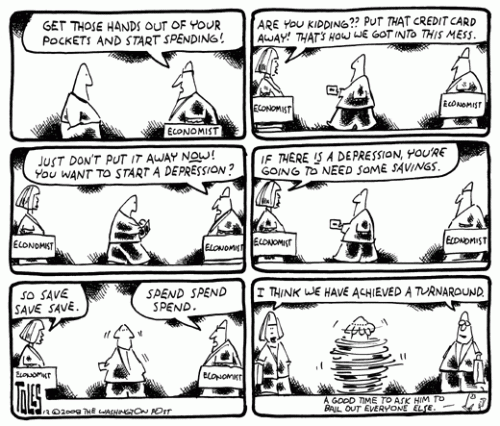
The Spend/Save Paradox

What to do? Spend! Save!
What?
There was recently a very good article at the Town Square blog on the mixed messages of economists as well as the problem we individually face in ensuring our own future. The message to spend essentially says that it is your patriotic duty to get out and stimulate the economy. OK. And buy what? Go to the Dollar store where nothing purchased effectively stimulates the the local economy? Go to Best Buy and purchase a flat screen TV (made in Korea)? I think not. If we want to stimulate the economy effectively then stop doing what we have done for years. Stop buying the cheapest item and buy something that will give your neighbour a job. It is good for your neighbour and ultimately good for you.
It is also good for the planet as the resources are not shipped to Korea or China and then shipped back as a finished product. From the Town Square blog:
The solution to the Paradox (spend/save) is to demand, consume and produce the local and renewable. Keep whatever shrinking wealth we might have within sight, build local economic muscles, protect local jobs, and begin to construct a sustainable region and home place.

The problem is we don't have an easy understanding of what is made locally. Until we demand and attain meaningful identification of the origin of products we don't have much of a choice.
(editorial cartoon by Tom Toles, Washington Post)

Monday, 1 December 2008

Hardwood Life-Cycle Costs

HardwoodInfo.com has provided an excellent source of information on hardwood floors. Sustainability, indoor air quality and durability are all issues that need to be considered..... and its all very confusing. This .pdf file provides the best help I've seen. Of special note is a Life-Cycle Cost comparison this has been helpful in one our projects.

Sunday, 30 November 2008

Eco-Friendly Guide to Flooring

Eco Timber's Eco-Friendly Flooring Guide is a clear and very helpful source for information on sustainable hardwood flooring. Topics in the guide range from legal and illegal logging and responsible forestry to the presence of formaldehyde and other volatile organic compounds in the wood and adhesives. Eco Timber tackles every step in the process from subfloors to floor pads to the panels themselves. Looking for a specific hardness of wood? They've got a scale. Do you already have a hardwood floor and want advice on green care and maintenance? Eco Timber has a section on maintenance, surface scratching, and refinishing.

Wednesday, 26 November 2008

Green Kitchen


There are many components to a sustainable kitchen. If you are serious about being Green, here is a start for ideas:
· One green step that doesn't add to your costs is to select Energy Star appliances. Your refrigerator represents up to 15 percent of your total electric bill. Energy Star refrigerators today use 40 percent less energy than 2001 models, so an upgrade is likely to save you money.
· You can also save a considerable amount of energy by using fluorescent or LED lighting.
· Limiting the size of your kitchen is another important consideration—according to the U.S. Census Bureau, the average size of an American kitchen has increased 215 percent from 1950 to 2004. Consider how much space you really need.
· You can also incorporate sustainability into the function of your kitchen by recycling food containers and composting food waste.
· Flooring: Two relatively inexpensive options have been around for a long time: linoleum and cork. Both are extremely durable and come from natural, renewable resources. They are resilient (soft), which makes them comfortable to stand on. They come in an extensive range of colors or patterns. Both linoleum and cork are available as tiles or click-together systems you can install yourself. Linoleum is made from linseed oil, pigments, and pine rosin. There are no toxic products used in its production and it does not offgas VOCs. (Chemically sensitive individuals should be warned that it does smell of linseed oil.) Linoleum floors inhibit bacterial growth and if properly installed can last up to 50 years. Cork is made from the bark of cork-oak trees, which can be harvested every nine to ten years. The flooring sheets are made with waste from the manufacture of wine-bottle corks. For kitchen and bathroom floors, cork should be sealed. You can apply a water-based polyurethane at home, but I recommend ordering a floor with a factory-applied finish, which will last longer. (Be sure to verify the VOC content, as factory finishes often contain harmful chemicals.).
· Cabinetry: Choosing kitchen cabinetry can be confusing. There are many options: low- to zero-VOC panel products, FSC (Forest Stewardship Council) certified plywood, rapidly renewable agrifiber boards (such as wheatboard, made from the shaft of the wheat stalk, an agricultural waste product), or reclaimed wood. Cabinetry can also be expensive. Consider reusing your existing cabinet boxes and replacing only the doors.Countertops: The high cost of countertops like IceStone and Vetrazzo may contribute to the perception that green materials cost more. Trend Q, is a recycled-glass agglomerate that looks like Vetrazzo but is thinner (¼" thick). Depending on the complexity of the installation, Trend Q can cost half as much as Vetrazzo. (The product requires a certified installer.) Paperstone is another countertop you might consider. Again, the cost of the material and the installation is considerably less than IceStone or Vetrazzo. A ¾"-thick, very dense panel made from recycled paper, Paperstone is heat and water resistant.

Friday, 20 June 2008

Getting the Energy Source Wrong

One of my clients is trying to determine which method of heating is best for a new apartment building. One approach is what we have normally done for the past 20 years. The other method is new and a little scary. It sounds good. Others have tried it and it works, but it is more complicated. The choice is between a central boiler with natural gas as a fuel or a ground source heat system using individual heat pumps for each apartment, providing both heating and cooling.

What to do? My recommendation is to very seriously explore the ground source heat pump with the supplemental heat for hall pressurization coming from a passive solar wall and domestic hot water supplemented by solar water heaters. Am I sure this is the best approach? No. But a serious exploration is in order and electricity, as a back up, seems the best option. Here is why……

Last year David Hughes, now retired from the Geological Survey of Canada, in a March, 2007 taped interview with Julian Darley of the Post Carbon Institute suggested that we are in a very serious supply problem with natural gas. The following are a summary of the main issues:

1) In the 'Lower 48' the U.S. is very likely at or near peak coal production. As with any essential resource peak production will inevitably lead to a price spike and result in a period of frenzied exploitation. And while this will create a short-term plateau or at least mitigate the rate of decline nonetheless the writing is now on the wall for U.S. coal as it is for global oil production and North American gas production.

2) Canada has peaked in terms of natural gas production. We are now drilling 4 times as many wells as we did in the 1990's but this has not increased production. It has however enabled the production decline rate to be mitigated.

3) 77% of Canada 's putative reserves have yet to be discovered. Theoretical reserves should not be treated as being in the same class as those that have felt a drill bit.

4) The average production rate decline for Canada 's really existing wells is 20%!

5) The U.S. has also peaked in terms of natural gas production and currently relies on Canada for 15% of their supplies which is 55% of our production. (3.6 Tcf to 6.5 Tcf)

Chapter 6 of NAFTA the "proportional sharing clause" states that we must continue to export even "in times of scarcity". The average decline rate for really existing U.S. gas wells is 28%.

6) North America will be facing natural gas shortfalls in the near term. (David Hughes' number is 3 years "if we are lucky".) To put not to fine a point on it we heat about 50% of our homes with natural gas and 33% with electricity which is increasingly being made by using natural gas. Yes our winters are getting warmer still......

7) As we go down the energy food chain the energy return on the energy invested also goes down. Ghawar and its like were able to return 100 units of energy for every one invested. Off shore fields like the North Sea are good for about a 17 to 1 return. The tar sands according to Mr. Hughes 2:1. (He likens the use of natural gas to create syncrude as equivalent to "Turning gold into lead.")

These facts are well known inside the energy industry. What however is not acknowledged and has so far at least been wholly under appreciated by almost everyone is the following.

8) The green house gas implications of #7 are staggeringly immense! Effectively what #7 means is that if we use all of our considerable ingenuity and the immense wealth that we have currently to keep our current energy, production and distribution systems up and running then the next decade will see our GHG's be far higher than they are today. It will also mean that after those ten years we will have far less access to the very great amount of energy that will be needed to transition our current system to a renewable energy production and distribution system. i.e. A sustainable one.

The implication is that if the wrong choice is made now, the economic ability to switch to the other energy source will be very difficult. Switching to a different source will be done in the context of a weakened economy.

Monday, 19 May 2008

Watering Paradise

I stood watering Mother's petunias last week. They were looking fine. So were the geraniums. The grass was coming in nicely. All in all a fine Minnesota garden. Sadly it was in Apache Junction, part of metro Phoenix. On the other side of the wall was the desert, dry and brown as it moved into summer. Mom loves her garden and I don't say anything. As a good son I just hold the hose spilling out the precious water that is the life blood of a very large consumer-oriented population, living where they have no hope of sustainable living in those numbers. Some other observations:
  • Mom is careful about recycling pop cans which can be taken down to the club house. Everything else – everything- is headed for the landfill. There is no recycling program. Governments have no courage to do so as the voters, many on fixed income, will not tolerate the cost.
  • Roads are four and 6 lanes wide, even on secondary roads. They are largely deserted. The automobile is king. No one walks because of the heat. On the positive side, the boulevards are beautifully landscaped. Public realms are wonderfully designed and maintained.
  • No solar collectors. Then again, a shower did not need the hot water turned on – only 'cold' water.
  • I saw very few recreational vehicles. Most of the snow birds had left, but there were almost none on the road to Tucson. Everyone was complaining about the cost of gas.

We came back to Canada to cold wet weather, leaving behind 90º F and dry comfort. This week it is over 100º F and the petunias are dying. Arizona was oddly attractive and at the same time unreal. The guilty pleasure of an unsustainable life……… When gas is $10 a gallon, the city in the desert will likely suffer the same fate as the petunias.

Friday, 18 April 2008

Ontario to veto ban on clotheslines

At last. Common sense about laundry.
"Premier Dalton McGuinty is to announce today that clotheslines can no longer be banned in subdivisions or almost anywhere else in the province. In a bid to curb the use of energy-sucking dryers, the new regulation will overrule neighbourhood covenants – part of the mortgage agreement between many developers and homebuyers – that outlaw clotheslines because they're considered unsightly. The regulation, to take effect today, will not only prohibit new bans but also wipe out most that already exist, a provision that angered the province's building industry."
This is great news. In our neighbourhood we are the only people who hang out our laundry. We like the smell of wind blown clothes. We also like not running the dryer when it's 30 degrees outside. Come on people! What's wrong with airing a little clean laundry?

Friday, 4 April 2008

Great quote on Peak Oil

I found this post in response to an article in the New York Times by John Tierney, Are Carbon Cuts Just a Fantasy?"

"By Mid Century our fossil fuel resources are going to be so incredibly depleted and our population so large that we cannot afford to wait to invest in renewable technologies and conservation. This is regardless of whether we do anything about climate. The denial involved in ignoring the dysfunctional nature of our relationship with fossil fuels is astounding. When oil has risen for 5 straight years and the best new projects that we can come up with involve burning corn in our gas tanks, digging up tar in Alberta, or drilling into 8000 ft of water and 20,000 more of rock in the gulf of Mexico, we have a big big problem. "

Wednesday, 26 March 2008

Simmons on CNBC

It is quite frightening to hear this stuff, but there it is. Simmons may be wrong, but if he is not - and I believe he is not, then we need to make some lifestyle adjustsments now while we still have a choice.
"'Unless we have a very severe meltdown in the global economy, I think we would be better off assuming that China and India are going to lead the way of the developing countries starting to behave more and more like Japan did in the '50s and '60s,' he said.

'If that happens, then we need to be prepared for for one of two things: either bringing on supply to the tune of a new North Sea every two or three years — which is impossible — or watching demand outstrip supply. And finally we [will] create shortages that literally create a run on the energy bank, just like we had a run on Bear Stearns.'"
'Peak Oil' Debate - Oil and Gas * Energy * News * Story - CNBC.com:

Thursday, 20 March 2008

Market as God

Last night in discussion with members of the communications committee of the Smarter Niagara Committee about “Growth” as a cultural given in our society. Someone asked “Do we have to grow?” - almost afraid to ask because it sounds like a dumb question. It was a great question and in some ways the most important question.

Generally understood, growth has meant being able to consume more than before. We know, intuitively, there are limits. But the economy is built on the assumption of no limits. I was reminded of an article found in Atlantic Monthly some years ago, “The Market as God”. Harvey Cox – a Baptist theologian, discussed a parallel of the language of Market Capitalism with religious language. In reality it is not simply parallel. Market Capitalism is a religion and it wants its converts – all of us – to fulfill the mission of growing consumption without thought of limitations. Cox writes:

“There is, however, one contradiction between the religion of The Market and the traditional religions that seems to be insurmountable. All of the traditional religions teach that human beings are finite creatures and that there are limits to any earthly enterprise.

A Japanese Zen master once said to his disciples as he was dying, "I have learned only one thing in life: how much is enough." He would find no niche in the chapel of The Market, for whom the First Commandment is "There is never enough." Like the proverbial shark that stops moving, The Market that stops expanding dies. That could happen. If it does, then Nietzsche will have been right after all. He will just have had the wrong God in mind.”

This god needs to die. Our children will be required to take the last resources, the last bit of clean air and water, live with global warming, to sacrifice all in obedience. Something to think about that when you buy your next home: How much is enough? Which god do you serve?

Happiness: Giving to Others

The following in today's Toronto Star is quite interesting. Money "can't buy me love" but it can be an opportunity to help someone else be happy. Bill Gates may have it right afterall.
The end of all economic activity is not, and Keynes suggested, consumption. The end may be creating room for others to be happy. I suppose one could argue that this is included in what Keynes meant...... Quite a stretch isn't it.

New Canadian-led research, being published tomorrow in the prestigious journal Science, says that spending your money on other people makes you happier than lavishing it on yourself.

"Spending on others can make people happy, yet people might not foresee this ahead of time," said Elizabeth Dunn, a psychologist at the University of British Columbia and the lead study author.

"When we asked people to predict which of our conditions would make them happiest, they tended to think they'd be happier spending it on themselves than spending it on others," Dunn said.

Recent surveys, the study notes, have shown people in Western societies have experienced few gains in their overall happiness level over the past several decades, despite a dramatic surge in real income.

Indeed, previous research suggests that any money earned above the amount needed to cover basic needs generally buys little in the way of extra joy, even when it is used to purchase expensive cars and baubles.

"We suggest that how people spend their money may be at least as important as how much money they earn," the study says.

"Specifically, we hypothesize that spending money on other people may have a more positive impact on happiness than spending money on oneself."

Sunday, 16 March 2008

Plan C - For a post Peak Oil economy

It is interesting to see mainstream media now discussing peak oil with the assumption that it is real. Sadly it is and it will mean a substantial change in our life style. Responses tend to range from the suvivalists stocking up food and ammunition to a more reasoned "don't worry, we'll adapt in stages and won't even notice." The book, Plan C, represents some place in the middle. It is so easy to be wrong on how best to respond. Frugality, can't be all bad.

"Plan C explores the risks inherent in trying to continue our energy-intensive lifestyle. Using dirtier fossil fuels (Plan A) or switching to renewable energy sources (Plan B) allows people to remain complacent in the face of potential global catastrophe. Dramatic lifestyle change is the only way to begin to create a sustainable, equitable world. The converging crises of Peak Oil, Climate Change and increasing inequity are presented in a clear, concise manner, as are the twin solutions of community (where cooperation replaces competition) and curtailment (deliberately reducing consumption of consumer goods)."New Society Publishers - Plan C:

Wednesday, 5 March 2008

Economics 101 - The Story of Stuff

This is a wonderful piece of work! Who thought economics could be so simple? Annie Leonard shows us why we have so much stuff and why that has to change.

From its extraction through sale, use and disposal, all the stuff in our lives affects communities at home and abroad, yet most of this is hidden from view. The Story of Stuff is a 20-minute, fast-paced, fact-filled look at the underside of our production and consumption patterns. The Story of Stuff exposes the connections between a huge number of environmental and social issues, and calls us together to create a more sustainable and just world. It'll teach you something, it'll make you laugh, and it just may change the way you look at all the stuff in your life forever.

Monday, 3 March 2008

Son, Not Just a Straw Man

"The four walls enclosing the newest structure on the grounds of St. Lawrence College don't match. One has been constructed using conventional methods - wood with pink, cotton candy-like insulation.
Two others use Styrofoam-like insulation: one is made of Lego-type blocks filled with concrete in the middle (like an Oreo cookie of the construction world) while the other features a thick chunk of hardened foam. And, the fourth is made of straw bales.

The students building this hut, located next to the schools "Energy House". are interested in knowing which wall keeps in heat the best. 'I believe the straw bale is [the best] because of the sheer thickness of the wall,' said graduating student David Ferguson (MY SON!). 'We'll see. We don't really know.'

'We really need to educate people on the perception of building technology,' said Ferguson, 25. 'Anyone who's willing to listen, we'll give them a good spiel.'

The students, who are studying in the college's renewable energy program, also plan to hold a workshop on green roofs and a campus sustainability symposium later this month. The students started building the 140-square-foot hut in September after receiving a $17,000 grant from the provincial government to erect a demonstration structure showing four different types of insulation. The Whig Standard - Ontario, CA

19th Annual Environmental Awards

Niagara Region is looking for nominations for its 2008 Niagara Region Environmental Awards, one of the longest-running Environmental Awards programs hosted by any municipal government in Ontario. These awards recognize contributors to environmental conservation in the following categories - Lifetime Achievement for an individual who has made a substantial contribution to conservation over many years, Volunteer for individuals or community groups, Corporate for businesses and institutions, and Young People for elementary and secondary schools."

Contact Don Campbell at the Region.
Include your name, address, and telephone number when sending your nomination and clearly indicate which award the nomination is for. Deadline for submissions is March 28, 2008.
The Regional Municipality of Niagara - Region Seeking Nominations For 19th Annual Environmental Awards

Sunday, 2 March 2008

Real Estate and Peak Oil

The age of cheap energy appears to be over. Natural gas production in North America will peak in 7 years. Oil may have already peaked world wide. This does not mean we will be out of fuel, it does mean that it will be increasingly scarce and expensive. Our economy is built on cheap energy and will most certainly suffer.

This most certainly has real estate implications as increasing fuel prices will make suburban homes less valuable. Further homes that are energy inefficient will also have less value.

Buying & Selling for Hard Times - Dick Halverson

Energy Tsunami on the Way - Realty Times

Peak Energy - a selection of charts & quotes

The Long Emergency - J. Howard Kunstler