Friday, 29 March 2013

Housing Anniversaries

This has been a year of rememberance. It has been 25 years since the opening of Bethlehem Place and 20 years since the first Habitat for Humanity Niagara home.  I was there for both, as the development consultant for BP and chair of the Habitat board.  I've just been asked to attend a board meeting of Cornerstone Co-op, which I helped start 30 years ago, as a living artifact of the early days. 
My goal is to be there to celebrate the projects I am starting today.
See the St. Catharines Standard insert on the BP anniversary

Saturday, 25 August 2012

Myth of Aging in Place


One of our projects is in Niagara Falls where Covenant Care Niagara is working to create a new kind of nursing home in Ontario where aging is not considered an illness suitable for a large institution, but a fact of life, where, in a small setting, life continues to be meaningful, relevant, and important.


The inspiration comes from the Green House homes that are becoming very popular in the U.S. They are a change away from our institutional, medicalized model where advanced age is an illness.

Bill Thomas is the driving force behind this movement and I was struck by a comment he made in the linked article.
"Aging is, and has always been, a team sport. The myth of "aging in place" harms people by defining the decision to share one's daily life with others as failure. But a big piece of the reluctance to seek out new ways of living with others is the dread of institutionalization. People cling to their homes in large part because they fear life in a nursing home more than they fear death. These are solvable problems, but we can't and won't make much progress until we come to a vastly deeper appreciation for the value of "life beyond adulthood."
I suspect he is right about "aging in place" as a reaction against the alternative. For 10 years it has been the buzz phrase for progressive thinking on elder care. It should mean having sufficient supports to remain in one's current home not as long as possible, but rather until a better, more meaningful alternative makes better sense. One view is clinging to the last hope of independence. The other is ensuring any place one lives is the right place.


Tuesday, 3 July 2012

More Damage to Niagara Cities

Proposed Outlet Mall in NOTL.  Note the guard towers at entrances to keep out pedestrians.
On the June 8th Standard front page we saw three hospital sites are leaked and an “XL retail outlet” for NOTL proposed, all of them outside urban areas. Why are we again going to hurt ourselves?

Regional policy promotes Smart Growth which includes encouraging diverse walkable neighbourhoods with healthy and vibrant downtowns.  Yet we, through our politicians, continue to permit non-urban development that ensures further damage and sprawl.  This must stop.

Are we are really set on repeating the mistake of placing the St. Catharines Hospital outside of the urban fabric? Hospitals are a major urban asset that should be in neighbourhoods to be easily associated with residential and related commercial development.  

As for the Nike and Dockers outlet, tourists want an authentic regional destination. Locals, who will keep this QEW strip mall afloat for a while, will see it eventually die, but not before this economic leech damages the really interesting places, including our downtowns (see www.deadmalls.com).  

For years we have known we must be smarter about development to reduce our infrastructure costs, ensure a resilient sustainable environment, and make for more livable cities; and then we get this.

Monday, 25 June 2012

CBC Coverage of Cordage Green

We had an excellent bit of coverage on the CBC National on Cordage Green.  What is most exciting about this project is the broad support we have in the community.  This is going to be extraordinary. 
The comment in the video about homes at $100 ft2 is unfortunate.  That would be construction costs only.
See the video/

Keep track of the progress at www.cordagegreen.ca

Monday, 31 October 2011

Trees have property value

I've know it for years, but had no real proof. Trees add value to property. Trees imply permanence, continuity with nature, privacy from neighbours, and above all, shade - no pun intended.
If you doubt this, just ask someone in an older neighbourhood how upset they would be if their neighbour cuts down their trees. Answer? Not happy at all. They intuitively feel the value of the own property decline.
Nice quote:  Best time to plant a tree?  Twenty years ago.  Second best time?  Now.
What?  Did you think the natural environment was all about you?

Monday, 20 December 2010

New Kiwanis Seniors Project

 Mayor Brian McMullan speaking at the announcement of funding for the Kiwanis Project on Geneva Street. The 40 unit, 6 story building will add to the 100 seniors units already on site next to the Fairview Mall.

Also on hand was the Regional council Chair, Peter Partington, MPP Jim Bradley, and MP Rick Dykstra.

We are the development consultants for this project. Occupancy is scheduled for November 2011.

Valley Way Project

Construction is underway at 6009 Valley Way, converting the old St. Michaels High School into 34 apartment units for seniors.  Occupancy is scheduled for June 1st. 

We are the development consultants.

This is the first phase for this project that will later include life lease independent and assisted living units.

Tuesday, 30 March 2010

One-fifth of Canadians can’t afford their homes

This is quite sad. One in four can not afford to own their own home, counting those who living in subsidized housing. While home ownership is not a right or often not desirable, this is not about choice, it is about an unequal distribution of wealth.  From theToront Star:
A new study from an Ottawa-based economic think-tank suggests that about 20 per cent of Canadians are struggling to afford the homes they’re living in and that national productivity is suffering as a result. The Conference Board of Canada says three-quarters of Canadians are living in homes they can afford, while about five per cent live in housing subsidized by the government. That leaves about 20 per cent of people who are struggling to cope with the cost of their homes.
One-fifth of Canadians can’t afford their homes: study

Tuesday, 2 March 2010

So why should I worry?

The Atlantic Monthly has some interesting observations on the disconnect between acknowleging the reality of climate change and actually believing it will have a personal effect.
Yale climate change research scientist Anthony Leiserowitz. The survey asked Americans, “Who will be most harmed by climate change?” Respondents said that climate change would mostly affect:

• Plant and animal species: 45 percent

• Future generations of people: 44 percent

• People in developing countries: 31 percent

• People in other industrialized nations: 22 percent

• People in the United States: 21 percent

• Your local community: 13 percent

• Your family: 11 percent

You personally: 10 percent

This explains a lot.  Most importantly it explains the lack of urgency to prevent the worst climate change scenario.  Climate change is believed to be true, but in practice, supporting change with personal implications, like gas tax increases, get little support.  It is little wonder that politicians, even those who understand the implications, are so unwilling to act.

The study also showed that Americans are not alone in this.  The disconnect is a world wide phenomenon. 

Wednesday, 11 November 2009

Oil crunch

It has been awhile since posting anything here. So here are some miscellaneous items around a predicted energy crunch:
From popular science an interesting chart that is likely wildly optimistic and news of several former staff members. “IEA Whistleblower Claims Agency Has Downplayed Looming Oil Shortage According to a senior International Energy Agency official, the energy watchdog agency fears the truth would trigger panic buying.” Of course former staff members who refuse to give their names may not be the most reliable sources. Still, look at the chart. It is likely wishful thinking.
To back up the concern, here is a recent Glob & Mail blog by Jeff Rubin:
"At that rate, the world has to find no less than 20 million barrels per day of new production just so the global economy can burn the same amount of oil in 2014 as it burns today. That’s why, in the oil business, you have to run faster to stand still. And even if global production can keep up with that treadmill, that leaves no allowance for any growth in demand."
What will this mean for house prices? I hope you are living close to work, shopping, and schools. If you want to move to those locations, be prepared to pay more.

Monday, 24 August 2009

Limited Energy Options


The following is from the David Hughes presentation summary given on March 9 to the Alliance for a Sustainable Colorado. We simply can not continue consuming in the way we have accepted as normal in our life time. The car culture, the Wal-mart culture, the suburban culture, the consumer society. . . . all of it, will change. Our children, in our life time, will ask us why we consumed so much and left so little for them. Hughes, a retired geoscientist with the Geological Survey of Canada, makes five essential points.
  • The five-fold expansion of global population since 1850 has been made possible by non-renewable fuels, the consumption of which pervades all aspects of society –food, transportation, communication etc. (Before 1850 population growth was relatively flat.)
  • The eight-fold expansion of global per capita energy consumption since 1850 has been entirely a result of consumption of non-renewable energy. (Oil, and then natural gas, made cheap goods possible.)
  • North America consumes a disproportionate amount of energy (5 times the global per capita average). The Developing World understandably aspires to North American energy consumption levels; however, finite non-renewable resources are unlikely to be sufficient to allow this to happen, setting the stage for global conflict over energy. (This will lead to paralysis in addressing global warming.)
  • The realities of the finite nature of non-renewable energy resources are now becoming evident –peak oil in many producing countries, peak North American natural gas, ten-fold increase in uranium prices since 2000, imports of coal into the US after centuries of self-sufficiency. (Peaks are defined as the point at which production begins an irreversible decline relative to demand.)
  • Despite the hype, renewable energy technologies are EXTREMELY UNLIKELY to be able to replace non-renewable energy in existing business-as-usual energy demand forecasts –a sustainable future lies in radically reducing and rethinking energy consumption. (A future that few political leaders are prepared to address, thus requiring individual action and responsibility - sorry no magic bullet.)

Monday, 27 July 2009

Bike-Friendly Homes


Some cities are better suited than others, but note this Realtor who focuses on helping people find homes that are "bikeable". The innovative Realtor who runs 'Tour de Homes' in Portland to show properties in neighborhoods that are bike and alternative transport-friendly is finding that despite a depressed market, business is booming.

Sunday, 24 May 2009

Prices are up?

This is a difficult picture to explain. Comparing April 2008 to April 2009 it appears that prices have increased by 2%. Volume is still down 21% reflecting a market that does not believe in itself. Many are having difficulty selling their home and afraid to offer on another with a "sale of property" condition. Look how uneven it is. Prices are down 12% in Niagara-on-the-Lake, but Niagara Falls, Thorold, Pt. Colborne, and Pelham are doing well. I have no explanation.

Residential Sales

2008

2009

Comparison

# of Listings

Average Sale Price

# of Listings

Average Sale Price

Volume Change

Price Change

NIAGARA-ON-THE-LAKE

22

355,649

18

311,667

82%

88%

NIAGARA FALLS

131

178,668

108

190,735

82%

107%

FORT ERIE

61

180,526

46

160,699

75%

89%

ST.CATHARINES

212

195,595

142

194,576

67%

99%

THOROLD

30

190,467

27

202,848

90%

107%

FONTHILL/PELHAM

23

262,696

26

284,388

113%

108%

WELLAND

87

172,190

58

168,260

67%

98%

PORT COLBORNE/WAINFLEET

35

147,817

37

170,468

106%

115%

LINCOLN/WEST LINCOLN

27

269,306

31

255,132

115%

95%

Totals

628

195,684

493

198,941

79%

102%

Sunday, 5 April 2009

The Best Value is Downtown

Linked here is an interesting article by Todd Litman from Planetizen discussing smart growth and the impact on affordability. For years we have put our social housing at the edge of urban development believing that avoiding infill NIMBYism was essential to achieving the housing at all. That was possibly true, but not as true today.

Right now I’m consulting on an AHP project located at the bleeding edge of new development. I regret the decisions that were made not to further pursue a downtown site after our initial effort. Hindsight is great and in retrospect government imposed timing conditions, project size, and the path of least resistance put us on that site. But in the long run we may have not done our residents a favour, especially as transportation costs rise.
That is a rental development, but for ownership – equity building suburban developments, the negative impacts are likely worse. It seems counter intuitive but the case made in this article is persuasive. Litman summarizes saying, “a typical household is likely to be a hundred thousand dollars wealthier in a decade if they choose a smart growth location over automobile-dependent sprawl.”

If we are going through “the great reset” as Richard Florida calls it, toward a new economy and new priorities, the Niagara Growth Strategy needs to be strengthen, not diluted by the pressures of old habits, to ensure we create the right conditions for good transportation options in our urban cores, and between the municipalities. Appreciation for high density urban living, by necessity, will evolve to be the new paradigm. Affordable rental housing efforts need to be there, involving smaller developments, multiple sites, and mixed with and in ownership housing.

Sunday, 29 March 2009

Formaldeyde and New Homes

This is from Green Building Elements and repeats a story that is missed over and over again. As bad as asbestos may be - and is as I have two cousins with mesothelioma - formeldehyde is much more common. It is in far to many products and is not labelled.

We recently tested several new homes for formaldehyde in the air. The newest home, advertised as a “green” home, had 300 ppb of formaldehyde. Children in homes with only 30 ppb can have decreased lung function. Between 60 ppb and 120 ppb, children are more likely to have asthma and chronic bronchitis.
At 100 ppb, most adults experience eye, nose, and throat irritation.
Of homes that were less than 2 years old, every home we tested had at least 100 ppb of formaldehyde. The newer homes had 200 - 300 ppb. The 300 ppb concentration we found in the newest home is equal to the 15-minute Short Term Exposure Limit (STEL) for occupational exposures. A worker in that home should wear a respirator to remain inside the building for more than 15 minutes. An employer that exposes workers to 300 ppb of formaldehyde should have a Hazard Communication Program to inform workers about chemical hazards and ways to avoid illness.

Tuesday, 10 March 2009

OREA fails the leadership test

It is sad to see my own people opposing a law that will significantly reduce green house gas emissions. This is a quote from the Ontario Real Estate Association article in their March 2009 Queens Park Plus newsletter. Get with the program folks. Show some leadership.
On February 23, the Government of Ontario introduced Bill 150 the Green Energy and Green Economy Act (GEA), 2009. Included in Bill 150 is a provision that will require all home owners to provide an energy audit report to prospective buyers. Currently, the bill is in the second reading stage of the legislative process. To read Bill 150 in full click here.
While OREA supports the principles of energy conservation and environmental stewardship that are enshrined in the GEA it opposes any policy that imposes unnecessary costs on homeowners and delays on real estate transactions. Instead, OREA supports the existing government program that encourages homeowners, through rebates, to assess the energy efficiency of their home voluntarily.

Wednesday, 7 January 2009

The Spend/Save Paradox

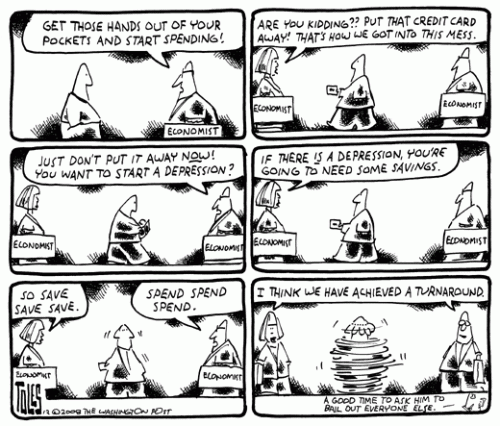
What to do? Spend! Save!
What?
There was recently a very good article at the Town Square blog on the mixed messages of economists as well as the problem we individually face in ensuring our own future. The message to spend essentially says that it is your patriotic duty to get out and stimulate the economy. OK. And buy what? Go to the Dollar store where nothing purchased effectively stimulates the the local economy? Go to Best Buy and purchase a flat screen TV (made in Korea)? I think not. If we want to stimulate the economy effectively then stop doing what we have done for years. Stop buying the cheapest item and buy something that will give your neighbour a job. It is good for your neighbour and ultimately good for you.
It is also good for the planet as the resources are not shipped to Korea or China and then shipped back as a finished product. From the Town Square blog:
The solution to the Paradox (spend/save) is to demand, consume and produce the local and renewable. Keep whatever shrinking wealth we might have within sight, build local economic muscles, protect local jobs, and begin to construct a sustainable region and home place.

The problem is we don't have an easy understanding of what is made locally. Until we demand and attain meaningful identification of the origin of products we don't have much of a choice.
(editorial cartoon by Tom Toles, Washington Post)

Friday, 12 December 2008

Are We Really Happier as Owners?

The great dream of all is to own your own home. It supposedly is a sign of a successful life. Now with the economic downturn, maybe its time to see if that was ever really as good as it seemed. According to the Wharton School’s Grace Wong in a study of those who own their own homes. Those who own are actually less happy than those who rent.

I find little evidence that homeowners are happier by any of the following definitions: life satisfaction, overall mood, overall feeling, general moment-to-moment emotions (i.e., affect) and affect at home… They are also more likely to be 12 pounds heavier, report lower a lower health status and poorer sleep quality. They tend to spend less time on active leisure or with friends. The average homeowner reports less joy from love and relationships… Contrary to popular belief, I do not find significant differences in family-related time use patterns, family-related affect, number of normal work hours, indicators of stress or measures of self-esteem and perceived control of life by homeownership …

Homeowners are happier on average only on an unadjusted basis. Once household income, housing quality and health are controlled for, they are no happier than renters. What’s more, they report to derive more pain from both the neighborhood and their house and home. This positive pain gap remains stable and robust when health, neighborhood characteristics and financial stress are controlled for. As for the most frequently cited channels of a positive impact by homeownership, namely self-esteem, stress, health and family life, again there is very little supporting evidence in my data… [H]omeowners spend less time on active leisure activities or with friends, which have been documented as some of the most enjoyable affective experiences.

Thursday, 4 December 2008

Property values holding their own

These are the latest average sales prices using MLS data. It is clear we are not facing the same difficulties that we hear about in the US. So many buyers and sellers think our economy behaves like our neighbour to the south. No so, at least not now. Look at Niagara Falls and Pelham. Values have not move much at all. For the entire region there is only a 2% drop.

Month = Last November and This November
YTD =November to November

Monday, 1 December 2008

Hardwood Life-Cycle Costs

HardwoodInfo.com has provided an excellent source of information on hardwood floors. Sustainability, indoor air quality and durability are all issues that need to be considered..... and its all very confusing. This .pdf file provides the best help I've seen. Of special note is a Life-Cycle Cost comparison this has been helpful in one our projects.